
Baseball Workout Program: A Comprehensive Guide
Baseball practice plans, often available as downloadable PDF resources, emphasize balanced muscle development and tailored training, like a six-week strength gain program.
Baseball conditioning demands a holistic approach, moving beyond simply hitting and fielding drills. A comprehensive program, often outlined in readily available PDF guides like the Baseball Practice Plan Guide, prioritizes balanced muscular development; These resources emphasize that effective conditioning isn’t about bulk, but about optimizing the muscles crucial for baseball-specific movements.
Many programs, such as those geared towards pitchers, focus on velocity and intent phases, utilizing structured schedules. Coaches benefit from free PDF practice plans, reducing planning time and ensuring consistent, well-rounded athlete preparation. These plans often integrate warm-ups, hitting, fielding, and speed work.
II. Understanding Baseball-Specific Physical Demands
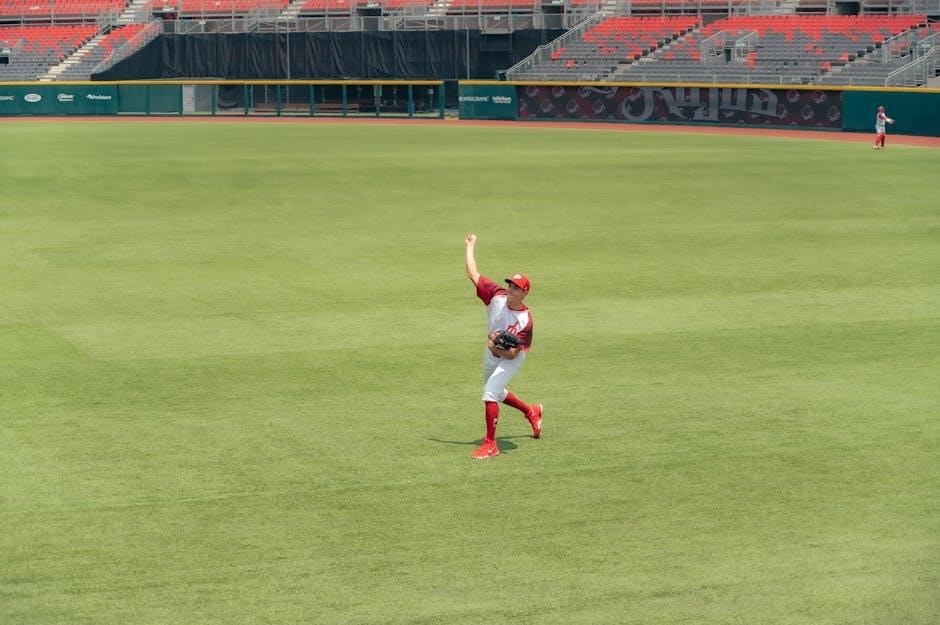
Baseball uniquely stresses the body, requiring explosive power, rotational strength, and exceptional agility. PDF resources detailing baseball conditioning programs highlight the need to address these specific demands. A six-week strength program, for example, aims to improve power output, crucial for hitting and throwing.
Pitchers, in particular, benefit from programs focusing on arm care and velocity development, often outlined in downloadable guides. Effective training considers the economy of movement, ensuring efficient energy transfer. Understanding these demands is paramount when designing a tailored workout, as detailed in various practice plans.
III. Warm-Up Routine for Baseball Players
A comprehensive warm-up is vital before any baseball activity, preparing muscles and joints for the demands of the game. Many baseball practice plans, available as PDF downloads, begin with standardized warm-up routines. These typically include dynamic stretching to increase range of motion and blood flow.

Prioritizing arm care and shoulder pre-activation is crucial, especially for pitchers, as detailed in specialized training guides. A proper warm-up minimizes injury risk and maximizes performance, setting the stage for effective hitting, fielding, and throwing drills, as outlined in various workout resources.
A. Dynamic Stretching Exercises
Dynamic stretching forms a cornerstone of effective baseball warm-ups, often detailed within baseball practice plans offered as PDF guides. These exercises involve controlled movements that increase blood flow and prepare muscles for activity. Examples include leg swings, arm circles, torso twists, and walking lunges.
Unlike static stretching, dynamic stretches don’t hold a position, instead focusing on movement through a full range of motion. Implementing these exercises before training, as outlined in many workout programs, enhances flexibility and reduces the risk of strains and injuries during gameplay.
B. Arm Care & Shoulder Pre-Activation
Baseball PDF resources frequently highlight the critical importance of arm care and shoulder pre-activation. This component aims to prepare the throwing arm for the demands of pitching or fielding, minimizing injury risk. Exercises often include rotator cuff strengthening with resistance bands, scapular retractions, and external/internal rotation drills.
Proper pre-activation enhances shoulder stability and improves throwing mechanics. Many workout programs suggest incorporating these exercises before each practice or game, ensuring the arm is adequately warmed up and ready for explosive movements. Consistent arm care is vital for long-term player health.
IV. Strength Training Program for Baseball
Many baseball workout PDF guides emphasize a strength program focused on balanced muscle development. These programs typically span several weeks, aiming to increase strength, size, and power output. A core component involves both lower and upper body exercises, tailored to the specific demands of the sport.
The goal isn’t simply bulk; it’s functional strength. PDF resources often detail specific exercises, sets, and repetitions, designed to improve athletic performance on the field. Time weight room workouts strategically around practice and games for optimal results.
A. Lower Body Strength Exercises
Baseball workout PDF guides consistently highlight lower body strength as crucial for power and explosiveness. Exercises like squats and their variations – front squats, back squats – are foundational, building overall leg strength. Lunges and split squats are also frequently included, enhancing unilateral strength and stability, vital for baseball movements.
These exercises improve the ability to generate force from the ground up, translating to increased bat speed and throwing velocity. PDF resources often provide detailed instructions and progression plans for these lower body staples.
Squats & Variations
Baseball workout PDF materials frequently emphasize squats as a cornerstone exercise for lower body power. Variations like back squats build foundational strength, while front squats enhance quad development and core stability – both critical for rotational power. Many programs suggest incorporating goblet squats for improved form and accessibility.
PDF guides often detail proper squat technique, emphasizing depth and controlled movements. Progressive overload, increasing weight or reps over time, is a common theme. These variations collectively contribute to enhanced athletic performance on the field.
Lunges & Split Squats
Baseball workout PDF resources consistently feature lunges and split squats for unilateral leg strength – crucial for baseball’s asymmetrical movements. Forward lunges, reverse lunges, and walking lunges are common variations, improving balance and coordination. Split squats, often performed with a rear foot elevated, further challenge stability.
These exercises, detailed in many PDF guides, target glutes, hamstrings, and quads individually, addressing imbalances. Proper form, maintaining a stable core and controlled descent, is emphasized. They are vital for generating power during hitting, throwing, and fielding.
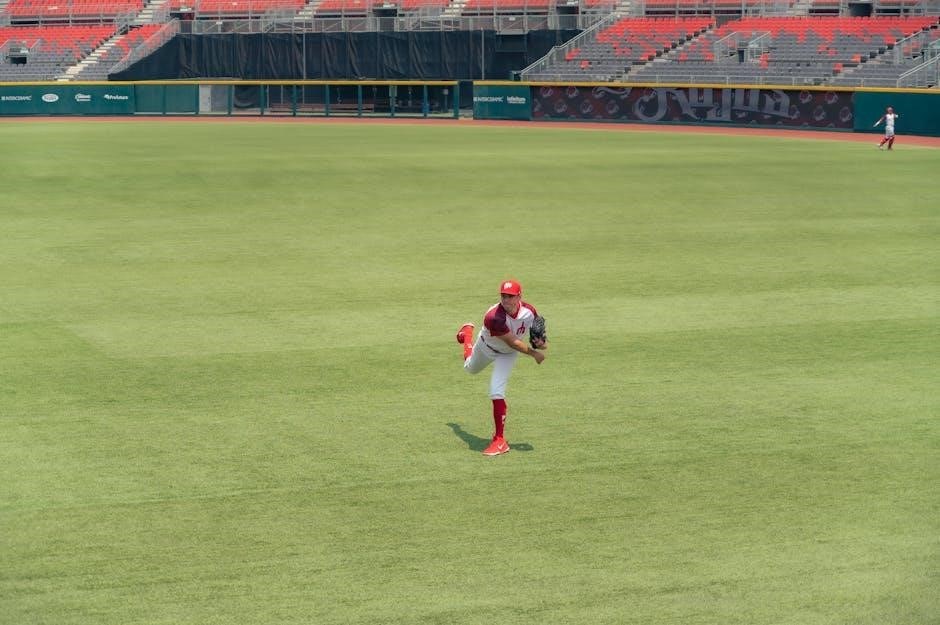
B. Upper Body Strength Exercises
Baseball workout PDF guides prioritize upper body strength for throwing velocity and bat speed. Bench press variations – flat, incline, and decline – build chest and triceps power. Push-up variations, like diamond push-ups, enhance specific muscle activation. These exercises, frequently detailed in downloadable PDFs, are foundational for overall upper body strength.
Pull-ups and various rowing exercises (barbell, dumbbell, cable) develop back and biceps strength, essential for rotational power. Proper form and controlled movements are consistently emphasized within these program resources, ensuring injury prevention and maximizing gains.
Bench Press & Push-Up Variations
Baseball workout PDFs commonly feature bench press variations – flat, incline, and decline – to target different chest muscle groups. These builds strength crucial for power transfer during hitting and throwing. Detailed PDF guides often include progressive overload strategies for the bench press.

Push-up variations, such as diamond push-ups, focus on triceps development, vital for elbow extension during throwing. PDF resources emphasize proper form to maximize effectiveness and prevent injury. These exercises, often outlined in weekly schedules, contribute to upper body power.
Pull-Ups & Rows
Baseball workout PDFs prioritize back and bicep strength through pull-ups and various rowing exercises. Pull-ups, even assisted variations, build upper back strength essential for rotational power during swings and throws. PDF guides often detail progression plans to increase pull-up repetitions.
Rowing exercises – barbell rows, dumbbell rows, and cable rows – target different back muscles, enhancing overall upper body strength. These exercises, frequently included in weekly schedules found in PDFs, contribute to improved posture and injury prevention for baseball players.
V. Core Strength & Stability Training
Baseball workout PDFs consistently emphasize core strength as foundational for power transfer and stability. A strong core facilitates efficient movement during hitting, throwing, and fielding. These PDF resources detail exercises like planks, Russian twists, and medicine ball rotations.
Stability training, often integrated into weekly schedules, focuses on exercises that challenge balance and proprioception. This improves a player’s ability to maintain control throughout dynamic movements. Core work is often positioned after strength workouts, as outlined in many downloadable PDF guides.

VI. Baseball-Specific Power Development
Baseball workout PDFs highlight power development through plyometrics and medicine ball training. Plyometric exercises, like box jumps and depth jumps, enhance explosive power crucial for hitting and fielding. These PDF guides often detail progression, starting with lower-intensity drills.
Medicine ball workouts, frequently included in practice plans, focus on rotational power and core engagement. Drills involve throwing against walls or with partners, simulating game-like movements. Many PDF resources emphasize proper technique to maximize effectiveness and minimize injury risk.
A. Plyometrics for Explosiveness
Baseball workout PDFs consistently feature plyometrics to boost explosive power. These drills, like box jumps and depth jumps, improve the rate of force development – vital for hitting, throwing, and fielding. PDF guides often structure plyometric progressions, starting with low-intensity exercises to build a foundation.
Detailed PDF resources emphasize proper landing mechanics to prevent injuries; Variations, such as single-leg hops and lateral bounds, target different muscle groups. Coaches utilize these PDFs to integrate plyometrics into weekly training schedules, optimizing athlete performance.
B. Medicine Ball Training
Many baseball workout PDFs incorporate medicine ball exercises for rotational power and core stability. These programs utilize throws against walls, twists, and slams to mimic the movements found in hitting and throwing. PDF guides detail specific weight selections based on athlete level and exercise complexity.
PDF resources highlight the importance of maintaining proper form during medicine ball drills to maximize effectiveness and minimize injury risk; Variations, like overhead throws and chest passes, target different muscle groups. Coaches leverage these PDFs to build rotational strength crucial for baseball performance.
VII. Hitting Workout Program
Baseball workout PDFs dedicate significant sections to hitting drills, progressing from fundamental instruction to advanced techniques. These programs often begin with tee work and dry swings, emphasizing proper stance, swing mechanics, and follow-through. Subsequent drills, detailed in PDF guides, include soft toss and front toss exercises to refine timing and contact.
Many PDF resources outline structured hitting routines, incorporating multiple groups and varying drill intensities. They emphasize consistent practice and provide cues for correcting common swing flaws. Coaches utilize these PDFs to build a comprehensive hitting development plan for players of all levels.

A. Tee Work & Dry Swings
Baseball workout PDFs consistently highlight tee work and dry swings as foundational hitting drills. These exercises, detailed in downloadable guides, focus on establishing a mechanically sound swing without the variable of pitched ball timing. Tee work allows players to repeatedly practice proper stance, hand position, and weight transfer.
Dry swings, also emphasized in PDF resources, reinforce muscle memory and swing path. These drills build kinesthetic awareness and promote efficient movement patterns. Programs often suggest specific tee heights and swing focuses, ensuring players address key elements of their technique.
B. Soft Toss & Front Toss Drills
Many baseball workout PDFs detail soft toss and front toss drills as crucial for developing bat speed and hand-eye coordination. Soft toss, typically performed at close range, allows hitters to focus on quick hand movements and making consistent contact. Front toss, with slightly increased distance, introduces timing and tracking skills.
These drills, frequently outlined in practice plans, emphasize controlled swings and proper hitting mechanics. PDF resources often include variations, like focusing on hitting to different fields or working on specific pitch locations. They build upon the foundation established through tee work and dry swings.
VIII. Fielding Workout Program
Baseball workout PDFs commonly dedicate sections to fielding drills, emphasizing both ground ball and fly ball techniques. Ground ball drills, often detailed in practice plans, focus on proper footwork, glove positioning, and quick transitions for accurate throws. These drills build reaction time and fielding range.
Fly ball drills, also outlined in these resources, concentrate on tracking the ball, securing the catch, and making strong, accurate throws to bases. Many PDFs suggest incorporating partner work and simulated game situations to enhance realism and improve decision-making skills during fielding practice.

A. Ground Ball Drills
Baseball workout PDFs frequently detail ground ball drills, prioritizing footwork and glove positioning. These drills, often found within comprehensive practice plans, start with slow rollers, progressing to harder hit balls. Emphasis is placed on a low center of gravity, fielding the ball out front, and a smooth transition to throwing.
Many PDF resources suggest variations like forehand and backhand drills, and incorporating movement – charging, shuffling, and fielding off the glove side. Coaches utilize these drills to build reaction time, improve fielding range, and develop accurate throwing mechanics from the ground.
B. Fly Ball Drills
Baseball workout PDFs commonly include fly ball drills designed to enhance tracking skills and secure outfield play. These drills often begin with coaches hitting fly balls at varying distances and angles, focusing on proper positioning and communication. Players learn to read the ball off the bat, take efficient routes, and make secure catches.
Resources suggest incorporating drills with teammates, simulating game-like scenarios. Drills emphasize calling for the ball, judging depth, and utilizing proper glove technique. Advanced drills may involve catching balls while moving laterally or making diving catches, building confidence and athleticism.
IX. Pitcher’s Workout Program (Velocity Focus)
Baseball workout PDFs geared towards pitchers often prioritize velocity development through specialized programs. These programs typically incorporate weighted ball training, focusing on building arm strength and improving throwing mechanics. Emphasis is placed on a progressive overload approach, gradually increasing weight and intensity.
Resources highlight the importance of short toss days at 75-85% effort for arm conditioning after periods of rest. A velocity-focused phase demands careful monitoring of workload and recovery. These programs are best suited for pitchers actively engaged in high-intent throwing phases, aiming to maximize pitching speed.
X. Speed and Agility Training
Baseball workout PDFs frequently include speed and agility drills crucial for quick reactions and efficient movement on the field. These programs emphasize exercises like sprints, cone drills, and shuttle runs to enhance acceleration, deceleration, and lateral quickness. Agility training improves a player’s ability to cover ground quickly and change direction effectively.
Integrating these drills into a comprehensive training plan is vital. Coaches utilize downloadable plans to reduce planning time, focusing on drills tailored to baseball’s dynamic movements. Proper form and technique are paramount to prevent injuries and maximize performance gains.
XI. Sample Weekly Workout Schedule
Many baseball workout PDFs provide sample weekly schedules to guide players through a structured training regimen. These often incorporate strength training, speed and agility work, and baseball-specific drills. A typical week might include dedicated hitting days, fielding practice, and pitcher-specific workouts, alongside rest and recovery periods.
These schedules are designed to balance workload and prevent overtraining. Coaches leverage pre-made plans, like those from MVP Baseball School, to streamline preparation. Adjustments are crucial based on individual needs and position requirements, ensuring optimal development and performance.
XII. Nutrition for Baseball Players
While comprehensive baseball workout PDFs primarily focus on physical training, optimal performance necessitates a tailored nutritional approach. Fueling the body correctly supports energy levels, recovery, and muscle growth. A balanced diet rich in lean proteins, complex carbohydrates, and healthy fats is essential for baseball athletes.
Hydration is also paramount, especially during intense workouts and games. Many resources emphasize timing nutrient intake around training sessions to maximize benefits. Proper nutrition complements the program, enhancing strength gains and overall athletic capability.
XIII. Recovery and Injury Prevention

Many baseball workout PDF guides, though focused on drills and training, implicitly highlight the importance of recovery. Adequate rest and active recovery strategies are crucial for preventing overuse injuries common in baseball. Prioritizing sleep, proper hydration, and a balanced diet supports muscle repair and reduces fatigue.

Incorporating stretching and mobility work into a routine, alongside mindful warm-ups, minimizes injury risk. Ignoring recovery can negate the benefits of even the most well-designed program, hindering progress and potentially leading to setbacks.
XIV. Baseball Practice Plan Guide Integration
Numerous baseball practice plan guides, often available as PDF downloads, provide structured frameworks for integrating workout components. These guides typically outline a practice flow – warm-up, hitting drills, defensive work, and team situations – offering a template for applying program elements.
Effective integration involves aligning strength and conditioning with on-field drills. For example, a lower body strength session could precede ground ball drills, enhancing explosive movement. Utilizing these guides ensures a cohesive training approach, maximizing skill development and physical conditioning.
XV. Utilizing PDF Resources for Training
A wealth of baseball training resources are available as PDF documents, offering coaches and players structured workout programs and practice drills. These PDFs often detail specific exercises, drill progressions, and even weekly schedules, like the six-week strength program mentioned.
GoRouts provides free, downloadable baseball practice plans in PDF format, reducing coaching preparation time. MVP Baseball School offers home practice plans, also in PDF, tailored for infielders. Effectively utilizing these resources streamlines training and ensures consistent, focused development.
XVI. Monitoring Progress & Adjusting the Program
Regularly assessing player performance is crucial when implementing any baseball workout program, especially those found in PDF guides. Track key metrics like velocity, hitting exit speeds, and fielding accuracy. Compare these against initial baseline measurements to gauge improvement.
PDF resources often provide frameworks, but adjustments are vital. Consider individual player needs and responses to training. If progress plateaus, modify exercise selection, intensity, or volume. Consistent monitoring, informed by PDF-guided plans, optimizes results.
XVII. Importance of Rest and Active Recovery
Effective baseball training, even when following a detailed PDF program, necessitates prioritizing rest and recovery. Overtraining hinders progress and increases injury risk. Schedule dedicated rest days into your weekly plan, allowing muscles to repair and rebuild.
Incorporate active recovery techniques – light cardio, stretching, or foam rolling – to enhance blood flow and reduce muscle soreness. Many PDF guides suggest submaximal throwing days, like short toss, for arm recovery. Balancing intense workouts with adequate rest is paramount for long-term athletic development.
XVIII. Adapting the Program for Different Positions
A comprehensive baseball workout program, even one detailed in a PDF, isn’t one-size-fits-all. Position-specific demands require tailored adjustments. Infielders benefit from agility drills, while outfielders need speed and throwing power work.
Pitchers, as highlighted in velocity-focused programs, require specialized arm care and conditioning. Catchers need lower body strength and endurance. Review PDF resources offering position-specific drill variations. Modify exercises to address individual needs and maximize performance for each player’s role.
XIX. Long-Term Athletic Development in Baseball
A successful baseball journey demands a long-term approach, extending beyond a single workout program outlined in a PDF. Early stages should focus on foundational movement skills and injury prevention. As athletes mature, training intensity and specificity increase.
Periodization – varying training throughout the year – is crucial. Utilize PDF resources for age-appropriate drills and progressions. Prioritize consistent, progressive overload. Remember, athletic development isn’t linear; adapt the program based on individual progress and long-term goals.